Forensic genetic genealogy
I'll Be Gone in the DarkForensic genetic genealogy is the use of genetic relationships to guide the search for an unidentified person, rather than simply matching a crime-scene profile to a known individual. In the investigation of the Golden State Killer, it offered a possible route from partial or indirect DNA comparisons to family lines and, eventually, a name. The book presents that promise alongside repeated cautions: a database match is a lead to interpret, not an identification by itself, and the most powerful databases were not freely available to investigators.
From forensic profiles to family leads
The method sits within a changing forensic landscape. When the Orange County Crime Lab began incorporating DNA testing in the early 1990s, processing a case could take up to four weeks, and a sample needed to be relatively large and well preserved. Early profiling relied on RFLP analysis. Later methods could obtain a genetic fingerprint from a small trace of skin cells in hours. The contrast matters because genetic genealogy depends not only on interpretive skill but on having a usable DNA profile to compare in the first place.
The DNA Identification Act of 1994 authorized the Federal Bureau of Investigation to maintain a national database, and CODIS became the upper tier of a system fed by local and state laboratories. Crime-scene samples and qualifying suspect samples enter local systems; state databases verify and compare them before sending profiles onward to the national system. In California, submitted samples are automatically uploaded to the state database each Tuesday, while the state also collects DNA from jails and courthouses. These systems primarily enable comparisons with profiles already held by law enforcement. Genealogical searching asks a different question: whether a profile can point toward relatives, a shared ancestor, or a family name.
The Orange County experience illustrates what direct database matching could accomplish. In 1995, investigators began submitting DNA from old unsolved cases to a new California Department of Justice laboratory in Berkeley, where profiles of known violent offenders were being collected. Six months later, the first cold hit identified Gerald Parker as the killer of five women and connected him to an attack on a pregnant woman whose husband had spent sixteen years in prison for it. The husband was exonerated, and Parker was a month from release. That discovery was not forensic genetic genealogy: it was a direct match to a known offender. Its importance here is as a contrast, showing the investigative power of searchable databases while clarifying what family-based searching was meant to add when a direct match was unavailable.
Y-chromosome searching and its limits
Paul Holes experimented with public genealogical databases using a Y-DNA profile derived from the Golden State Killer’s DNA. Y-DNA follows the paternal line. Such sites compare selected markers and return surnames associated with people who may share a paternal ancestor. The number of matching markers and their genetic distance matter; a list of possible relatives is not equivalent to a close, identifying match.
In March 2013, Holes encountered what looked like an exceptional result. A profile at the top of the list shared the killer’s rare marker and eleven other markers, with a reported genetic distance of zero. Holes had not previously seen a zero-distance result. He prepared to contact Ken Clark, a Sacramento County Sheriff’s detective, then set out to drive to the place where the attacks had begun. The apparent breakthrough was a false match: retired Secret Service agent and amateur investigator Russ Oase had independently uploaded the same killer’s markers to the database. The two uploads had produced a mirror-image match, not a discovery of the killer’s family. The episode makes the method’s central evidentiary caution concrete: a striking database result can arise from the way profiles entered the system, not from a meaningful kinship connection.
Michelle McNamara’s Y-STR search produced another promising-looking but inconclusive result. A rare surname appeared near the top of a list, with a most recent common ancestor estimate placing the shared ancestor about eleven generations back at a fifty-percent probability. Experts explained that the search would require going back roughly 330 years and still offered only a fifty-fifty chance of finding a common ancestor. The result could not identify a person. Forensic genealogist Colleen Fitzpatrick nevertheless emphasized that multiple distant matches carrying the same surname could suggest a likely family name, while a range of different surnames might offer a broad indication of ancestry without narrowing the identity to one lineage. In this case, the variety of names left no single surname to pursue; the pattern suggested a German name and a family connection to the United Kingdom, but adoption or other breaks in a recorded family line could defeat that inference.
Larger databases and the privacy barrier
By 2016, consumer genealogy companies were building much larger databases through autosomal DNA tests, which examine genetic inheritance beyond the male line. For roughly a hundred dollars and a saliva sample, customers could receive a profile and potentially connect with previously unknown cousins. The book gives period-specific figures of 1.5 million profiles at 23andMe and 2.5 million at Ancestry.com. Unlike Y-DNA searching, autosomal matching could connect relatives across family branches and between men and women, making a distant cousin a possible starting point for tracing a perpetrator’s family.
That scale raised the prospect of submitting crime-scene genetic material and following a second- or third-cousin match toward the person who left it. But 23andMe and Ancestry.com would not work with law enforcement, citing privacy concerns and their terms of service. Michelle wanted investigators to be able to search those expanding databases, even though doing so would run against the companies’ rules. She had the killer’s profile on paper, not his saliva or a swab. The book also identifies legal and ethical questions, including privacy protections, the companies’ terms, and the Fourth Amendment to the United States Constitution. The database was described as a locked door: its contents might contain a useful relative, but the means and authority to enter were contested.
Genealogy within a wider investigation
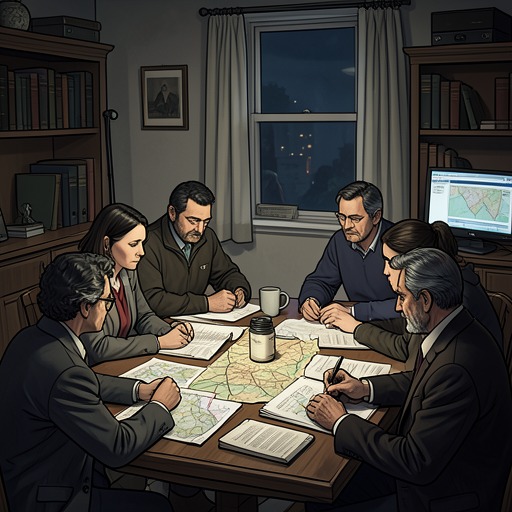
The book treats genetic searching as one investigative tool among many, not a substitute for casework. Michelle and Paul Holes discussed results with experts, and Michelle’s work combined DNA research with the collection and organization of investigative records. She built an index of people, places, and objects in official reports to locate leads, distinguish individuals, trace geographic movement, and identify possible connections among victims. Her growing exchange of information with active and retired investigators brought those findings back into the investigation.
In January 2016, Michelle and Holes were allowed to review and borrow selected materials from sixty-five boxes of case files at the Orange County Sheriff’s Department. At Michelle’s home, the materials occupied a former playroom, and two high-volume scanners helped turn paper reports into searchable files that could be shared with investigators, including Paul Holes, Ken Clark, and Erika Hutchcraft. The work offered a complementary form of searching: genealogy looked for relationships encoded in DNA databases, while indexing and digitization made scattered reports more accessible and searchable. Neither method automatically supplied an identity. Together, they show how the effort depended on profiles, databases, expert interpretation, archival records, and cooperation between investigators and researchers.
Forensic genetic genealogy therefore appears as both a technical possibility and a question of governance. Its usefulness depends on the size and composition of databases, the quality and meaning of a match, and the investigative work needed to test a family lead. Its reach is also shaped by privacy rules and institutional limits on access. The book’s examples resist treating a promising surname or an apparent match as a solution; they show instead how genetic clues become consequential only through careful interpretation and corroboration.